
Woven possibilities
and libraries of the future

I recently got to hold a talk with Egget at Munch Ung in which I discussed community, inclusion, and hopefulness for the future. I will be sharing the talk in written form here today:
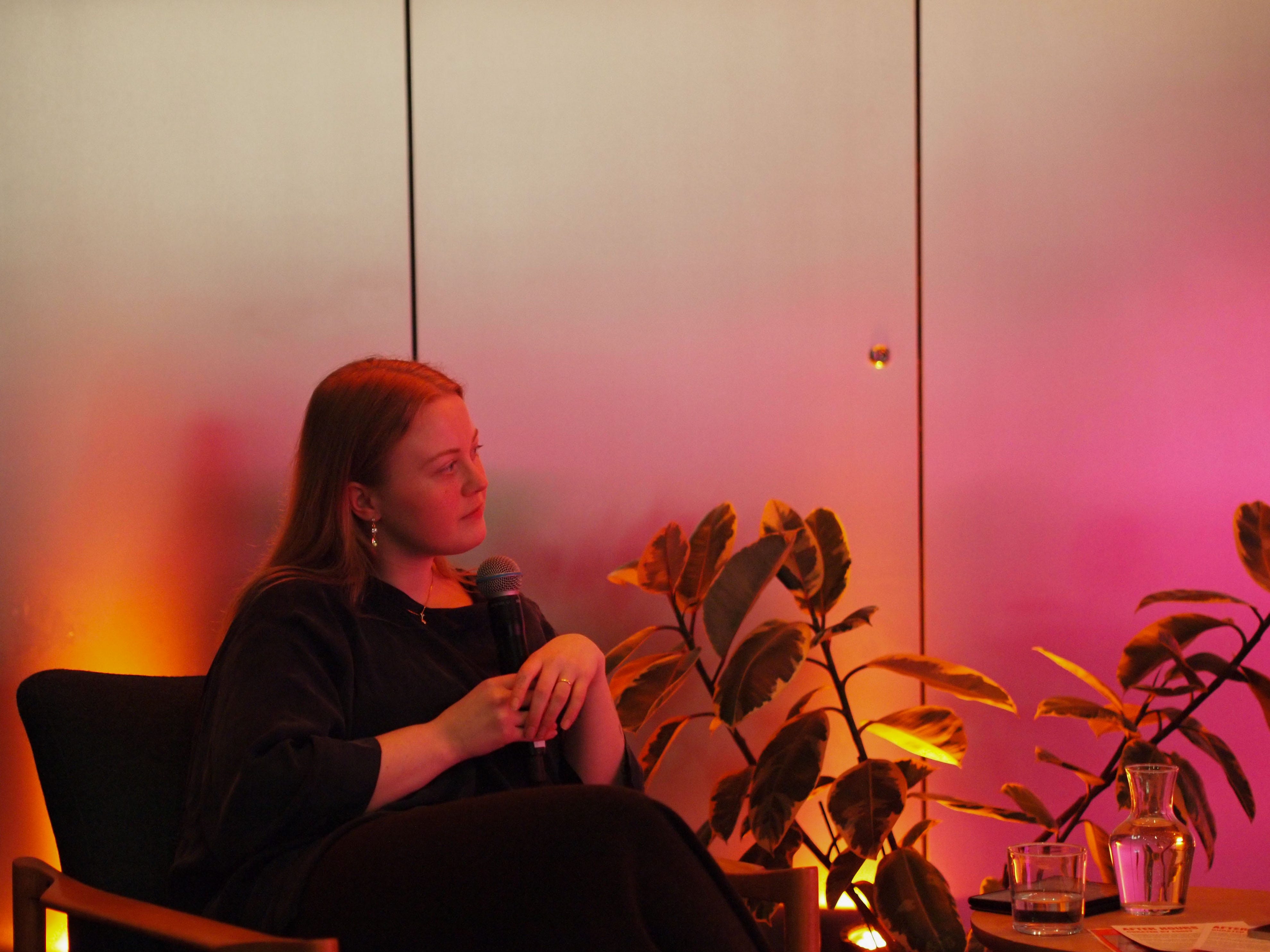
It is a common theme, especially after covid and the individualism that has taken root, to want to form deeper communities. I see this among my friends, my family, in articles and blogs. We divert from social media and seek something physical, somewhere we can meet people and see them and their true selves. People want analog memories rather than digital ones; want things that will last, that will be remembered, that will not get trapped into the streams and rushing of the internet. We want to belong somewhere. To not be lost. To be able to contribute to something bigger than oneself. We see it, for instance, through MUNCH Ung. Opening their doors to allow people to come together to learn and socialise during the afterhours.
What signifies an open room? When is a room, albeit physically open, actually open to all? How do the open rooms of the future help us find hopefulness for the future while dealing with the horrors we see today? How can we make sure that we keep opening up our spaces to people even though the digital world keeps spreading and fear becomes a daily experience for many? How do we navigate the digital world in order to find community when we are unable to engage physically with the outside world? It feels a little like going against the flow when the opposition is so loud. Working with something like this when people are becoming more and more right-winged, when we are blaming painkillers on autism and making pregnant women fear using painkillers because that will make their child autistic - to be clear, tylenol does not cause autism.
Having explored access to libraries for neurodivergent populations, I find it equally important to discuss access to any institution promoting culture and information, as well as the third rooms we find along the way. First, however, I want to discuss community; the importance of, and the definition of, community.
Community and community development
Community can be defined in many ways, but I have enjoyed Nina Simon´s way since I learnt it:
Community is “a group of people who share something in common. You can define a community by the shared attributes of the people in it and/or by the strength of the connections among them” (Simon, N. 2016, The Art of Relevance)
In that regard, a lot of things can be community. Oslo-dwellers as a whole can be a community because we all live here, thus have something in common. LGBTQ+ people can be a community. You and your coworkers can be a community. The people at a cafe, can, for some time, consider themselves as being in a fleeting community. But a community can also be your found family, your study buddies, your workplace, you and your partner, you and your cats. There is very little limit to what constitutes a community in this regard, and I think that using this perspective can be important in strengthening people’s claim to and creation of communities. You can be a part of so many communities, without even thinking about it very much, but in order to feel included, you need to include and take up space in the communities that feel relevant to you. A singer might seek out a choir for a sense of community based on shared interests. A book-lover might seek out a local bookclub. Artists might attend art gallery events to meet other art-lovers. We might come here today in order to share something together if only for one evening. Community can be fleeting. It can last for a few hours. It can last for an entire lifetime. And some might come back if they feel safe enough, included enough, relevant enough. This is why I put so much focus on inclusion and relevance in community building. There needs to be something to tie you together with someone else. And if a community is to feel personal and deep and meaningful, it might take more effort than to simply live in the same city. Especially if this community is to bring with it a sense of actually belonging.
Mental health and wellbeing are two aspects that get affected quickly when someone feels isolated, left out, not connected to any immediate or clear community, lonely, or anxious. I will be researching this in the future, but several sources already state that isolation and poor mental wellbeing in autistic individuals who do not feel a sense of community or belonging is high. I suppose this also goes for many non-autistic individuals as well. Although some people might truthfully not mind solitude, others walk in confusion at how to enter something that feels relevant and safe for them. Being autistic or otherwise disabled might bring with it stronger barriers towards finding this sense of belonging, be it because of physical barriers or sensory and social ones. People struggle. And with the digital landscape becoming bigger, it brings with it more aspects of communities and possibilities for connecting with other people when you are unable to leave home, but it might also, for others, leave them stagnant and non-searching for those communities that are out there, that might be welcoming and good for them. It is a fine balance here between needs and wants and possibilities. And I think libraries can be very good spaces to create communities, both physical and digital, across various groups of people. Perhaps also connecting different people together and bridging several communities to at times get together as one.
What makes community building and inclusion difficult?
I think a lot of people are scared. I know I get scared at the prospect of trying to make inclusion possible for so many different people at a time. Most of my work has been with people on the autism spectrum, and though there are similarities that make for a diagnosis, it is a spectrum - people are different, have different needs and opinions. As Nina Simon said in her TedTalk on relevance, one person can see a library or museum or cafe and think that it seems intriguing enough to enter it, to take the steps to figure out if it is open, if it is accessible. This same place can for others seem scary, dirty, uncomfortable. It depends on your previous life experiences. And with neurodivergent individuals, or other marginalised groups, this experience can have been negatively coloured in community spaces previously, thus making this barrier to entering bigger. If you don´t know what lights are in there or how loud the sound is going to be, you might not want to seek out the space because the potential impact of negative sensory input may be bigger than your potential enjoyment of a space.
I talked to bibliotekarforbundet early in October this year and they asked me what people can do, and why people find it difficult to do these things. Again, I think fear is the culprit. Fear of doing wrong. Of being wrong. Of failing, of making someone uncomfortable, of making someone never come back, of making a mistake, of saying the wrong thing, of being perceived differently than planned. Imagine creating an event for autistic library users, and though all intention is on inclusion and people feeling seen, someone includes the puzzle piece or quotes autism speaks. Not out of malice, but simply because they do not have time or resources to research properly what the autistic community in general prefers (which, at the moment, is neither puzzle piece nor autism speaks). Doing something like this might scare people away from returning. And having this fear lodged in the back of your mind is a big barrier towards making things inclusive. The barriers are not only for the users that are to be included, but also for those who include.
Not only do I think people are scared of doing wrong in their inclusion-work, but I also think we as a nation are generally leaning towards a fear of trying new things, of putting ourselves out there, of being seen. It’s not like we tend to say hello to each other on the bus or in an elevator.
Even sitting here is slightly scary because I do not know who will show up; I do not know if my talk is relevant to you, I dont know if you will feel comfortable. But without trying, there is also no reaching people on the other side. Being open about this fear, and being open to meeting fear in a gentle manner, on either side of the community building aspect, I think is one of the most important factors in community building itself. If we do not push beyond the fear and listen actively to the responses we get from the attempt at inclusion, we will not get very far. Neither will we if we are scared to voice our experiences with an event, fearing that those who made it might become angry or sad if the feedback is negative.


Libraries of the future
As open, public spheres, libraries have an incredibly good opportunity to use their space and resources to help communities strengthen, help people find community, and help bridge communities together.
David Lankes says this quite simply:
“The mission of Librarians is to improve society through facilitating knowledge creation in their communities” (Lankes, R. D., 2011, The Atlas of New Librarianship)
Now, facilitating knowledge does not have to do only with teaching people about facts and the names of every dinosaur that lived. But about how they can communicate, discuss, generate new ideas, collaborate, and grow not only as individuals, but as a larger group.
Although my chosen profession is librarianship, this community inclusion can also stretch to museums, archives, cafes, community centres, universities, digital social platforms, markets, parks, workplaces and offices, hospitals, sports arenas, and so on – the main idea here is to listen to the users of the space, listen to the potential users of the space, and open up the doors of relevance to these people.
Libraries are working hard to become community centres. While often still being considered reservoirs of books, they are trying to bridge gaps between communities, services, information, knowledge, and health. I know some people who think they are being too much - why do we need to have tools for rent in a library? Why do we need to have seed libraries? What I think these people fail to realise is that a library is not only a place to store documents, but also a place to foster civic engagement. To help build something outside of the library as well. To help the people that need it. Elderly people who struggle with access to information in a digital world. Students who struggle finding available sources. People who may not afford a specific tool to upkeep their home. People who feel lonely. People who need somewhere warm to stay for a few hours. People without access to the internet, without access to a lot of the things that a library can provide.
In this regard, I both hope and think that libraries will become more and more social in the future. However, it is crucial to remember that social in the traditional sense is not always what is sought after. There needs to be areas where one can relax, feel safe, engage in society without having to outwardly communicate too much. A lot of people are getting scared of the prospect of the library as a community hub rather than a quiet hush-hush space for reading. Which I understand. Bjørvika, for instance, can be a sensory nightmare, despite being quite pretty. But at the right time of day it can be extremely comfortable to roam through. It is often not the library itself that provides sensory barriers, but the people in it. But we need the people in the library in order to foster community engagement. And so figuring out how to include those who may need more support, more quiet spaces, more solitude, is a crucial aspect to community building in the libraries of the future. Especially if the goal is to bring people from different areas of life together.
What can it look like?
I recently had a conversation with a fellow librarian and we discussed how aesthetics, design, and architecture can have a big impact on certain people. Of course, some do not care that much about aesthetics, but I have found that, often, people who have differing sensory needs, sensory sensitivities, and similar, also get highly impacted by aesthetics. When I did my master thesis on barriers to the library for autistic individuals, a big part of the theme brought forth in the survey was the visual surroundings. Calm colours, soft edges, soft furniture, inviting atmospheres, easy navigation, relaxing art.
Knowing this made me more curious about how art affects neurodivergency. This research area is called neuroart. Neuroart research has consecutively shown that art and aesthetics can impact neurological processes significantly. You can see this, for instance, with music and people with dementia and Parkinson’s disease. Additionally, research also shows how the pleasure centres of our brain can be activated by aesthetically pleasing paintings. Art has also been seen to engage the prefrontal cortex, which is crucial for focus and for deciphering meaning from sensory input (Hutson & Hutson, 2024, p. 12-13).
It is easy then to link creativity, art, and aesthetics with building community for underrepresented groups of people, especially the neurodivergent ones. This is supported by a document from South Scotland that focuses on how community engagement through creativity is especially “effective at developing community engagement, amplifying less heard voices, and supporting the development of community capacity and partnerships to effect real change” (The Stove).
Hutson and Hutson state, in regards to using art and creativity to form safe bonds for neurodivergent individuals, that:
the collective experiences of navigating a world designed for neurotypical individuals can lead to shared strategies among neurodivergent individuals for managing sensory overload or for enhancing communication and social interaction. These shared strategies can reinforce the community’s cultural practices, influencing how members of the neurotribe perceive and interact with both their social and physical environments, thus affecting their embodied cognition. (Hutson and Hutson, 2024, p. 16)
Thus, in the theme of this evening, not only can libraries host book discussions and book cafes, but they can also facilitate community building through tactility, through creating something together. For autistic individuals, for instance, as I suppose it is for very many other people as well, “parallel play”, or spending time together with people doing something next to them without specifically needing to talk, is an activity that helps form community without adding the pressure of socialisation or the pressure of immediately overcoming personal barriers. Not only does creating together help neurodivergent or otherwise disabled individuals come together to form strong bonds or simply find a feeling of belonging, but it also links us to the tradition of community, of creating, weaving, shaping, cooking, cleaning, sewing and knitting together. Traditionally perhaps mostly recognised as feminine activities, these were, and are, important aspects in fostering strong relationships and trust. These activities can also be part of promoting positive sensory experiences for people with sensory needs.


Predictability
Before I wrap up, I want to touch a little bit on the research I have done in terms of autism and libraries. Especially when it comes to aspects we can do something with, regardless of economic resources. Of course, it would be wonderful if every library had the opportunity to have a room designated for quiet, for being able to recover from negative sensory inputs. A room where you could dim and change the colour of lights, where you could choose seating according to your needs, where you could be alone or with a safe person for a while until it feels safer to come back outside. Or simply areas in the library where you have sound proof chairs, dimmable table lights, softer edges. Participants in my thesis survey stated that:
I understand that libraries need to evolve to attract more users, but I wish they could also be designed for those of us who need to limit sensory input to fully enjoy library services. ... We live in a fast-paced, noisy world, and many people would benefit from quieter spaces. My ideal library would offer the same services as today but with rooms where people can retreat to for a sense of calm.
I enjoy that libraries are social places, but it would be preferable to have areas where you can escape from noise – like quiet or sensory rooms. I avoid events because they seem intimidating, but I believe I ́d participate more if I knew they were accessible to me and others like me. ... Being able to borrow sunflower lanyards or noise-cancelling headphones at the entrance, without interacting with anyone, would reduce stress. I ́d also like a way to signal whether I ́m open to social interaction or not.
A place where everyone feels welcome. Where all the employed have had some sort of course or information about autism (or other neurodivergent people), for instance through universal design. That the sunflower lanyard program is familiar to the employed. That clear signage shows that everyone is welcome to events and provides relevant information. Calm use of light and warm colours on the walls and interiors. Sensory friendly furniture. Furniture you can sit or lay on in different ways. Good chairs with pillows. Good soundproofing. Access to quiet rooms and sensory rooms. The option to dim lighting to preferred needs or specific rooms or times in which this is possible. Events connected to special interests.
However, not all libraries have the resources to do this. Neither money nor time. And so it boils down to acceptance. Acceptance, knowledge about neurodivergence, and predictability. One participant stated that:
Because I ́m a woman who wears caps and sunglasses indoors due to light sensitivity, I ́m used to getting strange looks from people. But it feels especially uncomfortable when librarians stare or give me odd looks. It discourages me from asking for help, and it makes it harder to concentrate when I ́m trying to read.
Another highlighted that:
I think it would be helpful if librarians had more knowledge about autism and how it might manifest. That way, they ́d understand that some people struggle to express themselves or might not fully grasp the librarian ́s explanation.
Predictability in this regard comes in four themes: physical, communicative, sensory, and recreational.
Physical predictability pertains to being able to find your way, easily navigating a space, the ability to know where things are beforehand.
Communicative predictability is about clear communication and information, providing structure, and cultivating alternative methods of communication, such as digital solutions for asking for help (e.g., chat options to reference librarians or robotic assistants to reduce direct social interactions), options to write instead, and options to use communication tools.
Sensory predictability relates to being able to prepare for, control, or adapt the sensory input you will be meeting in a space.
Recreational predictability is seen as a state that can only be reached if the other three are in place. This type again focuses on sufficient information, available preparation beforehand, communicative options, and so on, but as means to be able to use the library recreationally - that is, spend time in it, attend events, meet friends, and so on.
If a space, be it library or otherwise, is predictable, it can become easier to access. If you know what is awaiting on the other side of the door, you can weigh the pros and cons of relevance instead of fearing that it might be too much and deciding against something that might actually be quite lovely. If you know that a place has a lot of visitors at three pm on Thursdays, but very few before lunch on Mondays, and you are sensitive to sounds, then you might choose to go on a Monday. But in order to make that decision, you need to have sufficient information to do so.
Through implementing sensory-friendly design, fostering understanding and acceptance, and providing services that cater to diverse needs, libraries can play an important role in promoting social inclusion for neurodivergent individuals and others struggling to access community and social life.
Wrapping up
I think, not only Covid, but also the world that has been demolished around us for the last couple of years (or, decades, or centuries for that matter) combined with digitalisation and individualism, is a key factor in wanting to feel a more defined sense of community. We see more and more these days, graphic images of death and violence. Nothing is hidden to us anymore. I wish disaster was not the main thing that makes us think twice, but it is often something negative that makes us divert and wish to change. We are faced with death every day, either on a global scale, seen in the newspapers, or in our own private sphere.
Being hopeful during times like these, in situations that can feel utterly hopeless, is a strength you need to carry with you, to share with your community. In building communities based on hopefulness for the future, we can start to merge together, like trees or fungi, towards a common goal of something better, something supportive, something inherently kind, while still building our individuality amongst others.
Now, I wish I could tell you exactly how to stay hopeful, but we are all so different. I think we need to seek hopefulness. In the little things. Together. Seeing places like this create community events that blend tradition and the future is something that makes me, at least, feel a little spark of hope for our future. Seeing people push against fascism and tylenol-lies and genocide, makes me hopeful, even though we are small and may not be able to do much, at least it is warming to see that good people still exist and they exist and work towards a safe future for us and those who come after us.
With that, I want to say thank you for listening to me, I know it was long, and I hope you were comfortable. We will do some weaving together now, and there is room to discuss either this theme or other things you have been thinking about lately.
After my talk, which was an extremely cosy experience, looking up at people weaving while I talked, I had a chat with Mags, both friend and creator of Egget together with Jutha, also friend. In this chat I was asked a few questions, some of which I want to try to answer better here. I have found that one of my social barriers is verbalising concrete thoughts on the spot and so I felt like some of my responses were lacking in depth.


I assume you have spent many days at the library as a child growing up? How did the local library back in the day compare to modern libraries today?
My local library as a child was pretty much a small room situated in what we call the “centre”. This building has a lot of empty spaces that used to host a dentist, bank, bakery, and so on, but which has ultimately closed down little by little. I am happy to see that they are trying to utilise the space they have with a secondhand store and at times art maker space. The centre has a grocery store and I think still has a hairdresser, and the little library. I have not been in that library in a long time. When I was little we used to go visit it during school hours to borrow books. I never saw it as lacking, although it certainly was small. I think there are three rooms altogether, and I think you can now access it with a keycard which does help a lot with accessibility to literature. The other library we have close-ish by is a 25 minute drive. This one is bigger and I have not been there since they refurbished, but I used to take a writing course after school there when I was younger and quite enjoyed it!
Did you miss that [spending time in libraries] growing up or did you find a similar safe space to develop a relationship with books and activities?
I read a lot of books at home. Me and my best friend read together, borrowed books from each other. It made my childhood very magical, I think. I have also enjoyed owning my books for as long as I can remember, always wanting to grow a library, so I have to say that, as a librarian, I spend far too little time actually borrowing books from libraries.
Moving to Bergen showed me how big libraries can be, and then to Oslo where there are several, is quite a dream! In upper secondary school the library was also simply a room, but I used to hang out there to find a sense of calm when I was overloaded. At the time I did not know I was autistic, and thought I had a panic disorder. But it turned out I was having meltdowns over negative sensory inputs and social demands. That little room was a safe haven for me. Especially since we could borrow books easily without interacting with anyone so it was often empty.
What I really love about these more modern libraries are all the cultural services they provide and how they can link people together and be safe social arenas. It does, however, bring with it the issue of sensory and social overload, and this can create a big barrier for many people. I hope that there will be more acceptance towards quiet spaces as well, but more low-key and less about quiet study areas. I think having several different spaces that meet different needs can be a good way to help people overcome some of their barriers to their library spaces.
You mention busy soundscapes, harsh lighting, and crowded places as stressors for neurodivergent people. Do you think there’s a reason why we see so many airports, museums, metro stations and shopping malls embody these aesthetics in particular?
I actually do not know. I suppose it is partly in order for people to see well, but also, as Jutha cleverly stated, that airports and metro stations and shopping malls at least, are often created in order to make people do their business and leave as soon as possible. They create quite a hostile environment a lot of the time, especially for people struggling with sensory sensitivities. There is also this trend for museums and art galleries to put extreme focus on the art and only the art, but I feel like this can also easily be done without harsh lighting. I usually pay attention mostly to the people in these places and feel overwhelmed by them, so I haven’t looked much at their light sources etc. I did, however, see in Alicante Airport that they had a big sign with information about sensory rooms which made me really happy. I wish I had had time to check it out, but we had booked transport we needed to get to. I also saw this at Zenia Boulevard, which, as well as providing sensory security, was my most comfortable shopping experience ever. I hope more shopping malls follow in their footsteps!
Bangkoks airport was very accommodating, with carpet floors, warm lighting, open spaces with smaller clusters of functional furniture. Clean toilets, etc. In comparison to Lisbon airport, which is a well known sensory nightmare, this seems to do the trick. What is needed for Europe and the US to follow in Thailand´s footsteps and do you think we'll ever get there?
As stated above, I have seen this approach towards more sensory friendly areas for instance in Spain. I also see that Haugesund Public Library has carpeted floors and well-sectioned areas. I don´t know if this was done with the purpose of sensory comfort or not, but it does help create an atmosphere that is easy to navigate and spend time in.
I think europe and the us have to realise on a deeper level (not only superficially in regulations and laws) that measures need to be taken in every area of social and personal life in order for these laws and regulations to be working as they intend to do. Proposing access for all will not become reality unless every space is made available to people regarldess of their (dis)ability. To do this, I think research and discussions need to be shaped towards those who can make a difference, and focus on how access can be created realistically with the resources at hand.
Sources
Hutson, J., & Hutson, P. (2024). Resonant Perceptions: Exploring Autistic Aesthetics through Embodied Cognition. Ought: The Journal of Autistic Culture, 5(2). https://doi.org/10.9707/2833-1508.1162.
Lankes, R. D. (2011). The Atlas of New Librarianship. The MIT Press.
Simon, N. (2016). The Art of Relevance. Museum 2.0.
Svaler, T. B. (2025). “A Place Where Everyone Feels Welcome”: Strategies for Creating Sensory and Socially Inclusive Public Libraries for Autistic Users. [Master thesis]. OsloMet. https://hdl.handle.net/11250/3209252.
Svaler, T. B. (2023). On making libraries and museums more accessible for autistic people. IFLA Journal, 50(1), 42-52. https://doi.org/10.1177/03400352231202516.